Showing posts with label Kennedy. Show all posts

Thursday, October 22, 2009

LIFE archives: The Oswald Russian Diary

oswald2 Google Book's decision to publish the archives of LIFE magazines continues to provide treasures to all those interested in modern history. Case in point, the July 10, 1964 issue (linked in cover photo) contains a fascinating article of the Russian diary of Lee Harvey Oswald. The handwritten  dyslexic journal was provided to LIFE by his widow, Marina, and allows an interesting insight into the mind of one of the world's most notorious assassins.

For example, Oswald gives a second-by-second recreation of his decision to reject his American citizenship on October 3, 1959 at the US embassy. Richard Snyder, the head consul in Moscow at the time met with Oswald personally and told him he was "a fool" for dissolving his American citizenship and, in an effort to delay any action, informed Oswald that the process would take some time. Oswald was adamant however, and insisted that Snyder take him seriously. Finally, Snyder tells him, "unless you wish to expound on your Marxist beliefs, you can go." 

It is interesting to cross-reference the diary with testimony from the Warren Commission hearings, Snyder himself was called to testify about that meeting. Here is are two excerpts:

SNYDER: As to his general appearance, I do recall that he was neatly and very presentably dressed. I couldn't say offhand whether he was dressed in a suit and shirt, though I think probably he was. At any rate, he presented a nice physical appearance.
I presume that he was well shaven. Otherwise, I would not have had this feeling about him--that he, in general, was competent looking.

He was extremely sure of himself. He seemed to know what his mission was. He took charge, in a sense, of the conversation right from the beginning. He told me in effect that he was there to give up his American citizenship. I believe he put his passport on my desk, but I am not sure. I may have asked for it. In general, his attitude was quite arrogant….

SNYDER: He told me, among other things, that he had come to the Soviet Union to live, that he did not intend to go back to the United States, that this was a well thought out idea on his part. He said, again in effect, "Don't bother wasting my time asking me questions or trying to talk me out of my position."
He said, "I am well aware" either he said, "I am well aware" or "I have been told exactly the kind of thing you will ask me, and I am not interested, so let's get down to business"--words to that effect.
Well, he was a very cocksure young man at that time.  I am not sure that he sat at all throughout the interview, but certainly in the early part of it he did not.  I asked him--I recall asking him to take a seat, and he said, no, he wanted to stand. He may have relented later on.

http://mcadams.posc.mu.edu/russ/testimony/snyder.htm

The Soviets themselves seem perplexed by Oswald and treat him with some degree of suspicion, posting him in Minsk with very limited movement inside the country.

According to the journal, it wasn't long before Oswald realizes Oswaldthat Soviet Union was not what he had expected it to be. Disillusioned with his new life, the drab surroundings and compulsory Communist lectures, Oswald has already had enough by the first of 1961 and petitions to return to the USA with his new wife.

All in all, the Oswald Russian diary is an interesting footnote to the history of the mid 20th century. If you are interested in reading the article it can be found at:

http://books.google.com/books?id=mkEEAAAAMBAJ&lpg=PA37&pg=PA26#v=twopage&q=&f=false

Once again, I would like to thank Google Books and Life Magazine  for allowing all of us to read once again the record of our past.

Sunday, October 4, 2009

Wednesday, October 29, 2008

More Quotes by JFK

Mr. Nixon, in the last seven days, has called me an economic ignoramus, a Pied Piper, and all the rest. I've just confined myself to calling him a Republican, but he says that is getting low.

John F. Kennedy, 11-5-1960

Let our patriotism be reflected in the creation of confidence in one another, rather than in crusades of suspicion. Let us prove we think our country great, by striving to make it greater.

John F. Kennedy, 11-18-1961

If a free society cannot help the many who are poor, it cannot save the few who are rich.

John F. Kennedy 1-20-1963

Those who make peaceful revolutions impossible will make violent revolutions inevitable.

Socialist?


Economic growth without social progress lets the great majority of the people remain in poverty, while a privileged few reap the benefits of rising abundance. Economic policy can result from governmental inaction as well as governmental action.

John Kennedy

Monday, October 27, 2008

Kennedy Revisited -2

On Sitting down with the Enemy

John Fitzgerald Kennedy
University of Washington's 100th Anniversary (November 16, 1961)

“It is a curious fact that each of these extreme opposites resembles the other. Each believes that we have only two choices: appeasement or war, suicide or surrender, humiliation or holocaust, to be either Red or dead. Each side sees only "hard" and "soft" nations, hard and soft policies, hard and soft men. Each believes that any departure from its own course inevitably leads to the other: one group believes that any peaceful solution means appeasement; the other believes that any arms build-up means war. One group regards everyone else as warmongers, the other regards everyone else as appeasers. Neither side admits that its path will lead to disaster—but neither can tell us how or where to draw the line once we descend the slippery slopes of appeasement or constant intervention.

“In short, while both extremes profess to be the true realists of our time, neither could be more unrealistic. While both claim to be doing the nation a service, they could do it no greater disservice. This kind of talk and easy solutions to difficult problems, if believed, could inspire a lack of confidence among our people when they must all—above all else—be united in recognizing the long and difficult days that lie ahead. It could inspire uncertainty among our allies when above all else they must be confident in us. And even more dangerously, it could, if believed, inspire doubt among our adversaries when they must above all be convinced that we will defend our vital interests.

“The essential fact that both of these groups fail to grasp is that diplomacy and defense are not substitutes for one another. Either alone would fail. A willingness to resist force, unaccompanied by a willingness to talk, could provoke belligerence—while a willingness to talk, unaccompanied by a willingness to resist force, could invite disaster.

But as long as we know what comprises our vital interests and our long-range goals, we have nothing to fear from negotiations at the appropriate time, and nothing to gain by refusing to take part in them. At a time when a single clash could escalate overnight into a holocaust of mushroom clouds, a great power does not prove its firmness by leaving the task of exploring the other's intentions to sentries or those without full responsibility. Nor can ultimate weapons rightfully be employed, or the ultimate sacrifice rightfully demanded of our citizens, until every reasonable solution has been explored. ‘How many wars,’ Winston Churchill has written, ‘have been averted by patience and persisting good will! .... How many wars have been precipitated by firebrands!’”

Sunday, October 26, 2008

Kennedy Revisited

World Peace and War

American University Commencement (June 10, 1963)
John Fitzgerald Kennedy

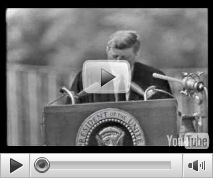
Kennedy Speech
“What kind of peace do I mean? What kind of peace do we seek? Not a Pax Americana enforced on the world by American weapons of war. Not the peace of the grave or the security of the slave. I am talking about genuine peace, the kind of peace that makes life on earth worth living, the kind that enables men and nations to grow and to hope and to build a better life for their children—not merely peace for Americans but peace for all men and women—not merely peace in our time but peace for all time.

I speak of peace because of the new face of war. Total war makes no sense in an age when great powers can maintain large and relatively invulnerable nuclear forces and refuse to surrender without resort to those forces. It makes no sense in an age when a single nuclear weapon contains almost ten times the explosive force delivered by all of the allied air forces in the Second World War. It makes no sense in an age when the deadly poisons produced by a nuclear exchange would be carried by wind and water and soil and seed to the far corners of the globe and to generations yet unborn.

Today the expenditure of billions of dollars every year on weapons acquired for the purpose of making sure we never need to use them is essential to keeping the peace. But surely the acquisition of such idle stockpiles—which can only destroy and never create—is not the only, much less the most efficient, means of assuring peace.

I speak of peace, therefore, as the necessary rational end of rational men. I realize that the pursuit of peace is not as dramatic as the pursuit of war—and frequently the words of the pursuer fall on deaf ears. But we have no more urgent task.

Some say that it is useless to speak of world peace or world law or world disarmament—and that it will be useless until the leaders of the Soviet Union adopt a more enlightened attitude. I hope they do. I believe we can help them do it.

But I also believe that we must reexamine our own attitude—as individuals and as a Nation—for our attitude is as essential as theirs. And every graduate of this school, every thoughtful citizen who despairs of war and wishes to bring peace, should begin by looking inward—by examining his own attitude toward the possibilities of peace, toward the Soviet Union, toward the course of the cold war and toward freedom and peace here at home.

.. Let us examine our attitude toward peace itself. Too many of us think it is impossible. Too many think it unreal. But that is a dangerous, defeatist belief. It leads to the conclusion that war is inevitable—that mankind is doomed—that we are gripped by forces we cannot control.

We need not accept that view. Our problems are manmade—therefore, they can be solved by man. And man can be as big as he wants. No problem of human destiny is beyond human beings. Man's reason and spirit have often solved the seemingly unsolvable—and we believe they can do it again. I am not referring to the absolute, infinite concept of universal peace and good will of which some fantasies and fanatics dream. I do not deny the value of hopes and dreams but we merely invite discouragement and incredulity by making that our only and immediate goal.

Let us focus instead on a more practical, more attainable peace—based not on a sudden revolution in human nature but on a gradual evolution in human institutions—on a series of concrete actions and effective agreements which are in the interest of all concerned. There is no single, simple key to this peace—no grand or magic formula to be adopted by one or two powers. Genuine peace must be the product of many nations, the sum of many acts. It must be dynamic, not static, changing to meet the challenge of each new generation. For peace is a process—a way of solving problems.

With such a peace, there will still be quarrels and conflicting interests, as there are within families and nations. World peace, like community peace, does not require that each man love his neighbor—it requires only that they live together in mutual tolerance, submitting their disputes to a just and peaceful settlement. And history teaches us that enmities between nations, as between individuals, do not last forever. However fixed our likes and dislikes may seem, the tide of time and events will often bring surprising changes in the relations between nations and neighbors.

So let us persevere. Peace need not be impracticable, and war need not be inevitable. By defining our goal more clearly, by making it seem more manageable and less remote, we can help all peoples to see it, to draw hope from it, and to move irresistibly toward it.”

LinkWithin

Related Posts with Thumbnails