
This is a reprint of an article I wrote from another blog. The subject is somewhat unpleasant but it is important nonetheless. Here is Part 2. It deals with the strange career of Ronald Roskens.
Second Strike
Second Strike
His promotion is definitely unusual because such an important government position would no doubt have involved a great deal of vetting to prevent such things as blackmail or, as in the events above, scandal. In the past the agency had provided millions of dollars in U.S. goods and services to foreign governments around the world so the possibility of corruption through extortion should have set off alarm bells. (Some have claimed the agency was nothing more than a CIA front- not such an easy allegation to dismiss as we soon see.)
As Eric Konigsberg, writer for The New Yorker, the New York Times Magazine, Rolling Stone, pointed out back in June, 1992
If he couldn't run a university, why should he be entrusted with a $7.5 billion government agency? Probably because his sponsor was Dick Herman, a Republican National Committeeman from Nebraska whose South Bay Beer Distributors company in Los Angeles, one of the largest Anheuser Busch distributors in the country, has listed James Baker and Bob Strauss as shareholders.
Unfortunately, failure didn't exactly chasten Roskens. At AID, he promptly ushered in friends like Katherine Morgan, his new head of the foreign aid policy office, whose resume included no work in government or international development, but stints as a nun, patent lawyer, and dean of college admissions. And then there was "consultant" Kermit Hansen, a regent at the University of Nebraska.
But the director has also had some help from the White House. To White House personnel staffer Tom Kranz, AID was a safe and profitable place to dump Sally Montgomery, a friend and former stewardess; there, she earns $90,000 a year as a deputy assistant administrator.While there's not always direct correlation between bad appointees and bad governance, under Roskens' leadership AID seemed to specialize less in international development than in the development of personal wealth. Since Roskens appointment, an impressive number of AID contractors and administrators have been sent to prison for rigging contracts, accepting bribes, and padding expense accounts. Roskens himself was forced to pay back more than $3,000 from an AID subcontractor for violation of ethical standards. And on three recent occasions, the federal government has required Roskens to reimburse private organizations, two of which are AID contractors, for honoraria or travel expenses he accepted illegally.
By October of 1992, after a year long investigation, Congressman John Conyers, Jr., chairman of Legislation and National Security Subcommittee of the Committee on Government Operations, confirmed that AID Administrator Roskens had abused his public office for private gain. While none of the charges in the investigation involved sexual abuse, they did outline a pattern of financial and ethical misconduct. In his letter to the Speaker, Conyers states:
A Textbook ExampleAlthough the AID Inspector General investigated and referred this same misconduct, the Justice Department declined to prosecute Dr. Roskens on charges of conflict of interest, illegal gratuity, and dual compensation. And when senior AID officials referred the Inspector General's findings to the White House, Presidential Counsel C. Boyden Gray only criticized two instances in which the Administrator inadvertently and unknowingly failed to comply with applicable standards of conduct, and demanded repayments from Dr. Roskens. No other disciplinary action was taken against the AID Administrator, although his domestic travel schedule fell dramatically.
In fact, Roskens, the University of Nebraska and AID had already had an on-going relationship even before President Bush, Sr. made this appointment. That relationship might go a long way in explaining how this unusual appointment occurred. While chancellor at University of Nebraska, Roskens had negotiated an exchange program with Kabul University in Afghanistan, and oversaw development of the center for Afghanistan studies.
Under an AID grant to the University of Nebraska-Omaha and its Center, the agency spent $51 million on the university education program in Afghanistan from 1984 to 1994. One part of that grant involved the publishing of textbooks in the dominant Afghan languages of Dari and Pashtu. In an effort to fight communism, and specifically the Soviet occupation, the textbooks were filled with violent images and militant Islamic teachings, part of covert attempts to spur resistance.
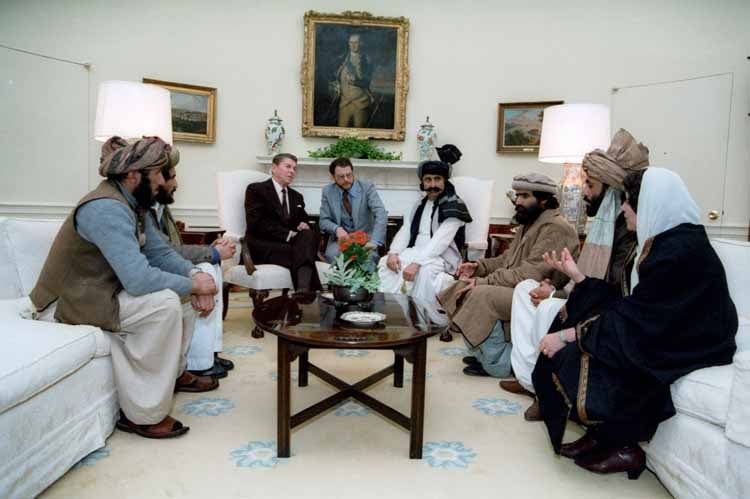 |
| President Reagan meets with Afghan "Freedom Fighters" |
It must have sounded like a good idea at the time, the indoctrination of children to generate Islamic militancy.
According to the Washington PostThe Mujahideen, Afghanistan's freedom fighters, used the classroom to prepare children to fight the Soviet empire. The Russians are long gone but the textbooks are not. The Mujahideen had wanted to prepare the next generation of Afghans to fight the enemy, so pupils learned the proper clips for a Kalashnikov rifle, the weight of bombs needed to flatten a house, and how to calculate the speed of bullets. Even the girls learn it.
According to The Genesis of Global Jihad in Afghanistan, quoted by Pervez Hoodbhoy, Pakistani nuclear physicist, essayist and political-defence analyst.During that time of Soviet occupation, regional military leaders in Afghanistan helped the U.S. smuggle books into the country. They demanded that the primers contain anti-Soviet passages. Children were taught to count with illustrations showing tanks, missiles and land mines, agency officials said. They acknowledged that at the time it also suited U.S. interests to stoke hatred of foreign invaders...
AID dropped funding of Afghan programs in 1994. But the textbooks continued to circulate in various versions, even after the Taliban seized power in 1996.Officials said private humanitarian groups paid for continued reprintings during the Taliban years. Today, the books remain widely available in schools and shops, to the chagrin of international aid workers.“The pictures [in] the texts are horrendous to school students, but the texts are even much worse,” said Ahmad Fahim Hakim, an Afghan educator who is a program coordinator for Cooperation for Peace and Unity, a Pakistan-based nonprofit.An aid worker in the region reviewed an unrevised 100-page book and counted 43 pages containing violent images or passages.
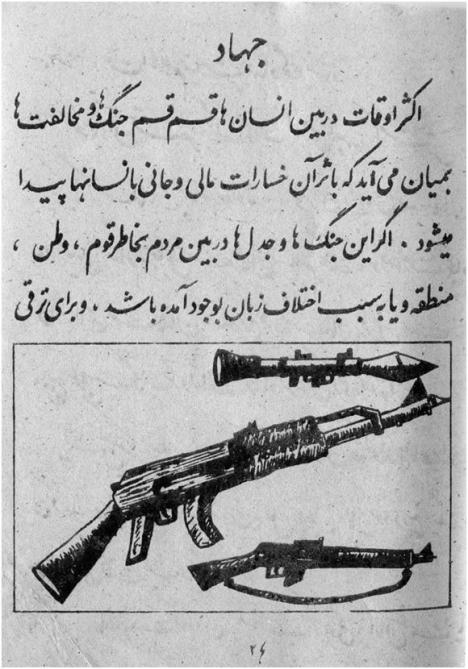
The program ended in 1994 but the books continued to circulate: ‘US-sponsored textbooks, which exhort Afghan children to pluck out the eyes of their enemies and cut off their legs, are still widely available in Afghanistan and Pakistan, some in their original form.
Another Twist of the Tale
As repulsive as this saga is, following it to its logical conclusion requires a very strong stomach.
After the invasion of Afghanistan of 2002, news reports about the militant textbooks made headlines. The headlines, however, failed to mention the actual source of the books. In response to this news, George W. Bush announced in a radio address that 10 million U.S.-supplied books would be shipped to Afghan schools would teach “respect for human dignity, instead of indoctrinating students with fanaticism and bigotry.”
The first lady stood alongside Afghan interim leader Hamid Karzai on Jan. 29 to announce that AID would give the University of Nebraska at Omaha $6.5 million to provide textbooks and teacher training kits.
Thus the same people who printed the original textbooks which preached religiously-inspired violence to children would now be the same people who would print books teaching secular respect for human dignity.
Most remarkably, at the time, the mainstream media were nearly completely fooled. (One notable exception was the Washington Post.) For example, Elizabeth Neuffer in the Boston Globe, March 17, 2002, wrote in an article about the obstacles to education in Afghanistan, a year after the US invasion:
The obstacles to accomplishing that goal are enormous. What few schools impoverished Afghanistan once had – about 2,000 – are now all virtually destroyed, pummeled by gunfire or turned into refugee camps. Teachers here have not been paid for months, even years. Those schoolbooks that still exist are pro-Taliban screeds and deemed unusable.
By not mentioning the source of the textbooks, Neuffer gives the impression that the books were written by the Tablian- or some other militant Islamic organization- and not the University of Nebraska, under the supervision of the US government.
The Daily Telegraph (Sydney), March 25, 2002, gives an even more misleading impression:
Closer to home, the Omaha World-Herald declared that,“Afghan children ran, skipped and dawdled to their classrooms like pupils everywhere yesterday for the start of a new school year — with girls and women teachers back in class and subjects like math replacing the Islamic dogma of the Taliban.“In a symbolic break from a war-scarred past, children opened new textbooks written by Afghan scholars based at universities in the US.“There are even pictures of people — images banned by the fundamentalist Taliban.”
“Afghanistan stands at least a chance of hauling a modern, healthy society up out of the ashes of war and oppression,” partly because University of Nebraska at Omaha “officials and staffers” will be “cranking up their presses in neighboring Pakistan” to churn out schoolbooks, all funded by “a $ 6.5 million grant from the U.S. Agency for International Development [AID].”
That promotional editorial is, at least explainable. The former publisher and Chief Executive Officer of the Omaha World-Herald, Harold W. Andersen, was also the Chairman of the Board of Trustees for the University of Nebraska Foundation. (It’s possible he even wrote the article but I cannot verify that.)
It is clear that Andersen also had connections to the Franklin Credit Union. He had headed a Franklin volunteer advisory board and back in 1986, led Franklin's building fund drive with $600,000 to pay for a renovation of the Franklin Credit Union. However, as one source tells us:
These money-raising efforts lost some of their luster in 1989, when it was revealed that the money was used to build an addition to the credit union, the most prominent feature of which was a bedroom. The retreat was equipped with "a brass bed, a fluffy white comforter, a stereo and a television," according to former Franklin employee Noel Seltzer, quoted in the March 5, 1989 Lincoln Journal. Others said King used it for afternoon trysts with his homosexual lovers.
Former Nebraska State Senator John DeCamp, author of the book The Franklin Cover-up, specifically implicated Harold Andersen as one of the top-five perpetrators in the child sex scandal. Those claims were based on hours of interviews with victims.
Be that as it may, what about Ronald Roskens, you ask? On November 18 1992, after only two and a half years at the agency, he became one of the first Bush agency chiefs to announce his resignation. Under a cloud of shameful scandal? I hear you asking. No. Not one little bit. More of a lateral move. Despite what others might consider a less than auspicious career, Roskens was apparently on the path to greater success.
In 1993, Roskens became president and chief executive officer of Action International, a think tank comprised of 35 former heads of state and other policy leaders. Just two years later, the Omaha, Nebraska, resident was named honorary consul general of Japan and was elected to the board of the Friends of the World Food Programme, a United Nations agency headquartered in Rome, Italy.
Additionally Roskens is listed in the “Who’s Who in America,” “Leaders of the English Speaking World,” and “Community Leaders of America.” Additionally Roskens has also received twelve Honorary Degrees from institutions of higher education around the world.
Interestingly- given the rumors in his past, Roskens was also honored with an induction in DeMolay Hall of Fame on June 25, 1993. According to its website, Related to the Freemasons, the DeMolay organization is:
dedicated to preparing young men to lead successful, happy, and productive lives. Basing its approach on timeless principles and practical, hands-on experience, DeMolay opens doors for young men aged 12 to 21 by developing the civic awareness, personal responsibility and leadership skills so vitally needed in society today. DeMolay combines this serious mission with a fun approach that builds important bonds of friendship among members in more than 1,000 chapters worldwide.
That is not to imply that this organization has anything to hide or that it has done anything wrong. Over the years, it has apparently accomplished a lot of good things to help young people rise out of their less-than-promising backgrounds. However, the same could be said for Sandusky’s Second Mile, which had also achieved many good things. It is all the more unfortunate that a single individual has been allowed to undo all that work and close the doors for any further assistance. As John Kennedy once said, “A nation reveals itself not only by the men it produces but also by the men it honors, the men it remembers.” The same is also true for organizations, such as DeMolay.
The story of Ronald Roskens is one of a systematic failure; namely, a consistent inexplicable tendency by authorities to reward improper conduct and poor performance. Governments, universities and corporations seem to expend greater energy attempting to cover pernicious wrong-doing rather than trying to remove the source and prevent its recurrence. Brushing it under the carpet and hoping the problem is never discovered seems to be the only reaction. In the Roskens affair, keeping lids on and brushing things under the carpet has been remarkably distressingly successful. But who suffers most? Clearly it’s the children. It’s the ones who are the most defenseless.
For at the end of the day, with the help of men like Roskens, we, as a nation, have helped to create a whole generation of anti-imperialist Islamic jihadist with school textbooks filled with hateful propaganda. We then armed their older brothers and fathers and uncles to fight our Cold War enemies without the slightest thought to the future. It never seemed to occur to anybody that these children, the children we indoctrinated with hatred and bitterness would someday grow up, that they would not simply disappear once they had served our short-term needs.
And when that did happen, when it was our turn to face their grownup seething hatred, what was our solution?
It was to exterminate them.
----------------------


